
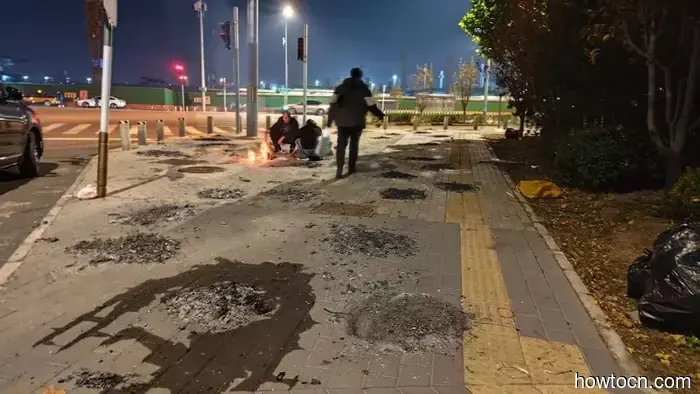
As you navigate through Beijing today, you may see locals creating makeshift bonfires on the sidewalks to burn paper. Rather than discarding trash or eliminating incriminating materials, they are honoring their ancestors through an ancient Taoist tradition.
Commonly referred to as 烧纸 shāozhǐ, which translates to "burning paper," this practice is carried out during several Chinese festivals, with one of the most significant being the holiday today, Tomb-Sweeping Day, or Qingming Festival (清明节 qīngmíng jié), marking the first day of the fifth solar term. Locals burn bundles of rough bamboo-based "joss" paper (often made to resemble "ghost" or "hell" money) and various paper replicas of items such as cars, watches, iPhones, and houses as offerings to deceased relatives, allowing them to enjoy a more comfortable afterlife.
To conduct the ritual, family members of the deceased typically draw a chalk circle to separate the living from the spirit world and ignite the money within this boundary. They often speak to their departed loved ones during the burning, expressing sentiments like “use this money wisely” or “purchase something nice.” While this practice is most prevalent during Qingming, it is also observed during anniversaries or other family-centric occasions.
What are the origins of this tradition?
The practice has Taoist roots and is a deeply embedded cultural custom in China. It is believed to have started with the ancient scholar Xin Xiaotang, who, unable to afford a coffin for his deceased mother, chose to keep her body at home. When questioned about his decision not to bury her, Xin explained that after spending many years together, the thought of being physically separated from her was unbearable.
Over time, the unsettling practice of keeping the bodies of loved ones at home became a custom, with adherence to this practice accruing more points of filial piety. Eventually, a magistrate's mother passed away, and unlike Xin, he was unwilling to tolerate the presence of her decomposing body in his home. He entrusted her to a monk at a nearby temple. Two days later, as her remains began to decay and the odor became unbearable, the monk had to burn straw and paper to mask the smell.
The next morning, the magistrate visited to check on his mother and asked the monk why he was burning paper. Fearing the ramifications of revealing the truth, the monk resorted to a common tactic for monks and lied, claiming he was making offerings to the magistrate's mother and explaining that the money burned in this world could be utilized in the afterlife.
Regardless of the true origins of the paper-burning tradition, it remains a significant expression of filial piety and a way for the living to honor their ancestors. More importantly, it serves as a moment for families to unite and cherish their time together in this world.
What's going on with all the fires on the streets?